
I did not expect this trip to unfold like a slow, looping sentence.
It began, as these things often do, with a landing in Los Angeles, that peculiar collision of fatigue and possibility humming under fluorescent airport lights. Then came Las Vegas, all spectacle and velocity, a place that insists on immediacy, on brightness, on the illusion that everything is happening at once. And now, Arizona. Quieter. Wider. A kind of silence that stretches. I am somewhere in the middle of it all, already thinking about the road ahead to San Francisco, before circling back to Los Angeles again, as if the journey itself refuses to be linear. These last few days, though, here in the desert, feel like the pause between movements, the moment where something unspoken begins to settle.
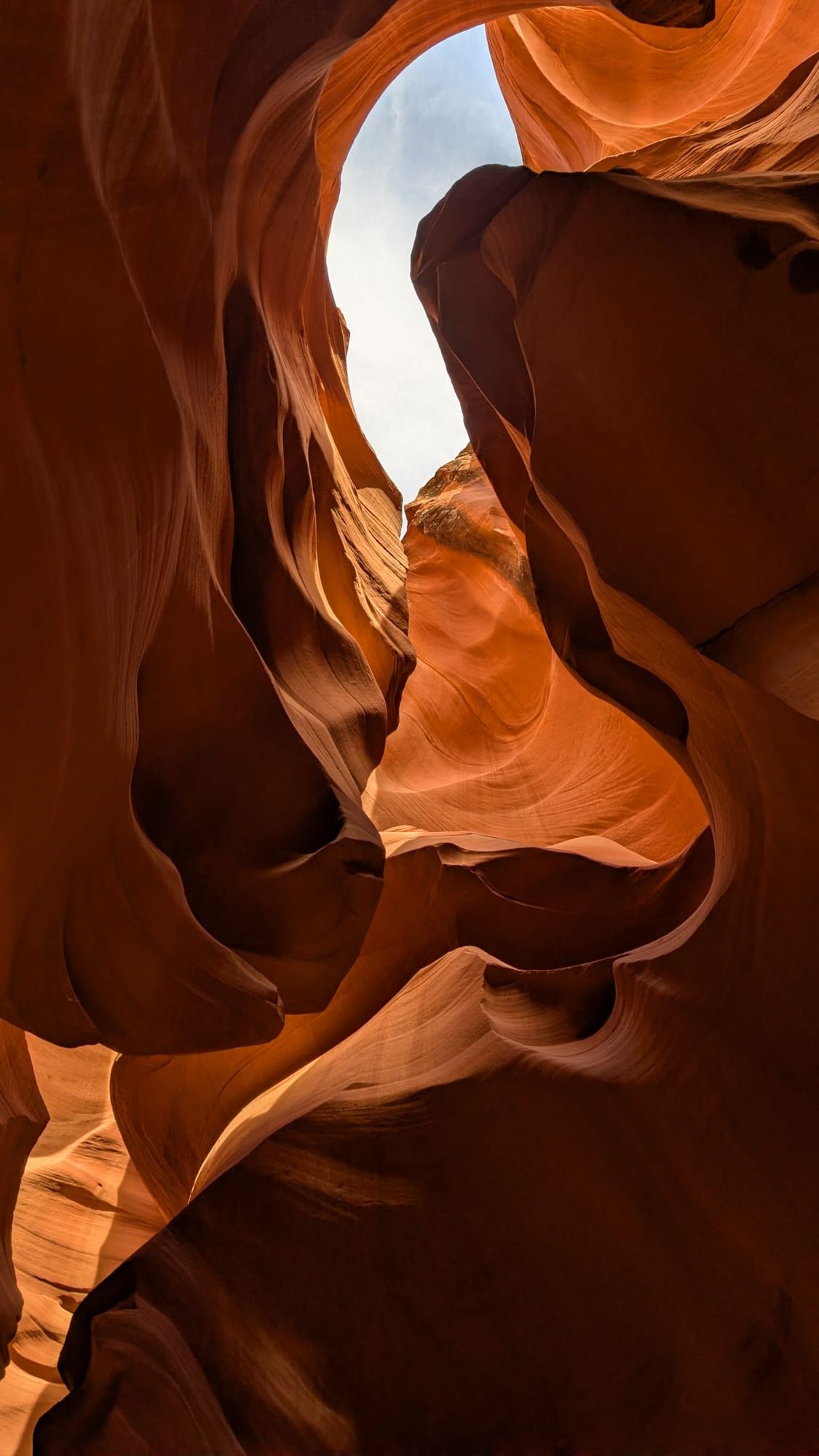
Antelope Canyon sits inside that pause.
Before there was a canyon you could book a time slot for, before the name “Antelope Canyon” appeared on travel itineraries, there was land that already held meaning.
For the Navajo people, or Diné, this landscape was never empty. It was not something to be discovered or framed or explained to outsiders. It was lived in, spoken through, understood as part of a larger order where land, story, and identity are not separate things.
Even the name most visitors learn, Tsé bighánílíní, feels different when you sit with it. The place where water runs through rocks. It is not poetic in the way we might expect. It does not try to elevate the place into something abstract or symbolic. It describes a relationship. Water moving through stone. Land shaped through contact, through persistence. A quiet acknowledgment of process.
That is often how Navajo stories move. Not toward spectacle, but toward connection.
The Diné origin stories speak of emergence, of passing through worlds before arriving in this one, of balance between forces rather than dominance over them. The land is not a backdrop in these stories. It is part of the narrative itself. Mountains, canyons, rivers. They are not scenery. They are participants.
This way of seeing makes certain histories harder to tell in the language we are used to.
Because the story of the Navajo people is not only one of continuity. It is also one of rupture.
In the 1860s, during what is now known as the Long Walk, thousands of Navajo were forced from their homeland by the United States government. Families were marched hundreds of miles to Bosque Redondo, an internment camp in New Mexico. Many did not survive the journey. Those who did arrived at a place that could not sustain them. The land was unfamiliar, the water poor, the conditions harsh.
It is difficult to reconcile that history with the stillness of a place like Antelope Canyon.
There is no visible trace of that displacement in the sandstone walls. No marker that tells you this land was once left behind under force, then partially returned through a treaty that could never fully restore what had been taken. And yet, the absence of visible evidence does not mean the absence of memory.
For the Navajo, the land remained part of who they were, even when they were removed from it. The canyon was not only shaped by water but also became places of refuge, where Diné people hid during the Long Walk, when removal, violence, and survival were not abstractions but daily facts of life.
That is something Western narratives often struggle to hold. We tend to separate place from people, history from landscape, as if one can exist without the other. But here, the two remain entangled.
Stories are one way that connection is preserved.
Not always in written form. Often spoken. Passed down, adjusted, carried forward. Stories that explain not just how something came to be, but how to live within it. How to move through the land with a sense of balance. How to understand that what surrounds you is not inert.
Even now, as Antelope Canyon has become a site of global attention, that underlying relationship has not disappeared. Access is controlled by the Navajo Nation. Guides are not just there to direct movement, but to mediate the experience. To remind visitors, sometimes subtly, that this is not simply a place to consume.
There is a kind of tension in that.
Tourism brings visibility, income, a way to sustain communities. But it also risks flattening the very stories that give the place its depth. Turning something layered into something immediate. Something shareable. Something that can be understood in a glance.
The challenge, then, is how to hold onto complexity.
How to allow a place to remain more than what is visible.
The Navajo stories do not resolve neatly. They are not structured for outsiders. They do not offer a clear beginning or end that you can step into and step out of unchanged. They exist in a continuum, shaped by both endurance and loss, by presence and absence.
And perhaps that is the closest parallel to literature.
Not the kind that explains itself fully, but the kind that leaves space. That resists easy interpretation. That asks you, quietly, to recognise that understanding is partial, and that some meanings are not yours to take.
The land holds those stories, whether you can read them or not.
And it does not rush to translate.